SNAP: Spay-Neuter Assistance Program
We have two SNAP options for low-income households in Wilkes County, NC:
1. "Regular SNAP" is our original program for Wilkes County residents who want to take their pets to Riverview Animal Hospital or Wilkes Veterinary Hospital. For information, see directly below. This is the only SNAP option for residents with dogs over 35 lbs. and all pets 5.5 years old and older, and it is recommended for all those who want to become a client at a local vet for future treatment for their pets, as needed.
2. "SNAP Mobile" is a mobile veterinary clinic that comes to Wilkes several times a year. Advanced registration and payment are required. Scroll down to see if "SNAP Mobile" will work for your pets. Please pay particular attention to the "limits" section.
Cost: The pet owner's "co-pay" for spay/neuter vouchers is $50 for female dogs ($60 if over 60 lbs.), $40 for male dogs ($50 if over 60 lbs.), $30 for female cats, and $20 for male cats. Please plan to pay the HSOW this amount, per pet, in cash or by card when you get your voucher. SNAP vouchers cover the full cost of the basic surgery and the required pain medication at our participating veterinarians. The vouchers will not cover the pre-surgery exam, special conditions or elective procedures, or vaccines. Ask for an estimate of possible additional costs from the veterinary office you are working with.
Participating Veterinarians:
Riverview Animal Hospital will accept both new clients and current clients with SNAP vouchers. New clients will be required to bring their pet in for a pre-surgery wellness exam prior to the spay/neuter appointment (approx. $60). Please tell them you plan to use a SNAP voucher when you make your appointment. Pets without a rabies vaccination will be given one at the pre-surgery exam for an additional charge. Please bring your records from the pre-surgery visit when you come to get a voucher.
Wilkes Veterinary Hospital will accept vouchers from current clients only. Please be sure to tell them you plan to use a SNAP voucher when you make your appointment. Wilkes Veterinary Hospital requires a pre-surgery wellness visit for pets they have not seen before (approx. $60), during which they will give a rabies vaccine if needed and make the spay/neuter appointment for your pet. Please bring your records from the pre-surgery visit when you come to get a voucher.
(336)667-1109
Vouchers are valid for six months. Contact This email address is being protected from spambots. You need JavaScript enabled to view it. if the date on your voucher is over six months ago. We reserve the right not to extend or reimburse a voucher issued more than one year from the date on the form.
Please keep in mind that all SNAP personnel are volunteers and the veterinary practices participate in our program voluntarily, despite a shortage of veterinarians. We are funded by grants and donations, not by your county or state taxes.
Next Open SNAP Voucher Registration: Friday, November 6, 11 a.m. - 12:30 p.m.
When you come to get a regular SNAP voucher, please bring the following with you:
-
Bring your spay/neuter appointment information and pre-surgery exam record from a participating veterinarian.
-
Bring your ID to show that you are a Wilkes County resident, 18 years old or older.
-
Bring proof of income in the form of a Medicaid and/or EBT card or other documentation (e.g. tax return) showing a household or self-supporting individual annual income (total or adjusted) of $35,000 or less.
-
Bring payment in cash (preferred, exact change if possible) or card: $30 for female cats, and $20 for male cats, $50/$60* for female dogs, $40/$50* for male dogs. (*Dogs over 60 lbs,)
-
Please do not bring your pet(s) with you to get the voucher.
Generally, we limit vouchers to two vouchers per person per month, toward a limit of six cats and two dogs per year, depending on availability of funds and vet appointments. Please do not apply for a SNAP voucher if you purchased your pet from a breeder.
Pets must have a current rabies certificate or receive a rabies vaccine before surgery for additional cost. There are some other conditions that may result in a higher cost for surgery, including a female in heat or pregnant or a male with cryptorchidism (undescended testicles). Normal pain medication is included in the cost of the voucher.
Residents requesting SNAP vouchers for feral cats will have to pay an additional fee (about $25) for a rabies vaccine and ear tipping, in addition to the cost of the voucher and other veterinary charges as described above.
Notes:
- The SNAP program applies for funds from the NC Dept. of Agriculture, which requires verification of income-related services from Wilkes D.S.S. This is why we ask to see your Medicaid or EBT card.
- Animal Ark-Elkin and Animal Hospital of Wilkes are currently not accepting SNAP vouchers.
- If you adopt a pet from the HSOW, Critter Ridge, Wilkes Rescue Group, or the Wilkes County Animal Shelter, spay-neuter at a local vet is already included in the adoption fee. You do not need a voucher, and you can get appointments with one of the local vets even if you are not a current client.
Other Regional Spay/Neuter Clinics:
The Humane Society of Catawba County accepts residents from Wilkes County at their Foothills Spay/Neuter Clinic in Newton, NC. Pet owners who are eligible for a SNAP voucher and want to take their pets to the Foothills clinic should contact This email address is being protected from spambots. You need JavaScript enabled to view it. to make arrangements. Those not eligible for SNAP may make an appointment themselves for low-cost spay/neuter here: https://catawbahumane.org/services/spay-neuter/
Another low-cost clinic nearby is Ginstone Spay, Neuter, and Wellness Clinic: https://ginstoneclinic.com/. Ginstone does not accept HSOW SNAP vouchers.
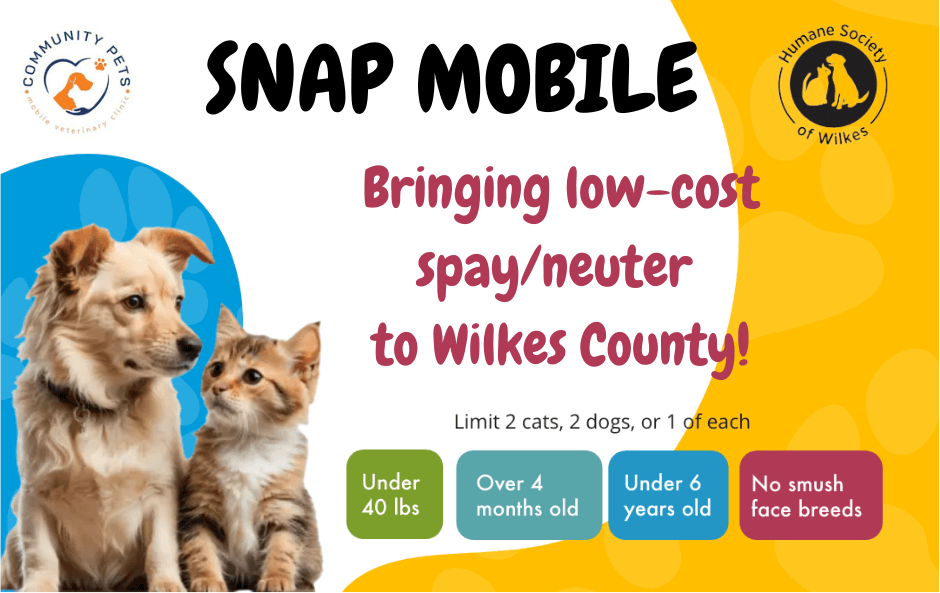
Next mobile clinic date: Monday, October 19, 2026
Oct. 19 Clinic: Full!
Applications for the November 13 SNAP Mobile Clinic will open 8:00 AM, Oct. 20.
The mobile clinic is not a walk-in service.
Pet owners must apply in advance, then, if approved, register and pay in advance.
Please read the limits, eligibility, and cost information below before applying.
Limits: Maximum of two friendly, not feral or aggressive, cats under 6 years old and over 4 months old by the clinic date. Due to higher risk, we cannot take “smush face” breeds such as Persian and Himalayan cats. (Regular SNAP vouchers can be used for dogs at participating local vets.)
Eligibility: Eligible pet owners must be current Wilkes County residents age 18 or older and must show proof of income: Medicaid, Food & Nutrition Assistance (EBT), Social Security, or other documentation (e.g. tax return) showing household or self-supporting individual income (total or adjusted) of $35,000 or less. Children’s Medicaid and Medicare cannot be used as proof of income.
Cost: The full cost of surgery and pain medication at the mobile clinic will be covered by a SNAP Mobile voucher for Wilkes County pet owners 18+ years old with current Medicaid or EBT cards. Vouchers require a "co-pay" of $30 for female cats, and $20 for male cats. A rabies vaccine is required by law, so pets without a current certificate of rabies vaccination will receive a rabies vaccine for $12 each. Some other veterinary services and vaccines will be available for additional cost and some pet health conditions may result in additional charges for treatments required during surgery. More information about additional services/treatments will be provided to those who register for the clinic. Registration and payment in advance is required to hold your pet's place in the clinic. We will be able to take about 30 pets at each clinic.
Application: This online application form will open on Oct. 20, 8 AM, for the November 13th clinic:
Health Benefits of Spaying and Neutering
Spayed animals no longer feel the need to roam to look for a mate. The result is that they stay home and have less chance of being involved in traumatic accidents such as being hit by a car. They also have a much lower incidence of contracting contagious diseases, and get into fewer fights.
In males, neutering decreases the chances of developing prostatic disease and hernias, and eliminates the chances of developing testicular cancer. It also reduces problems with territorial and sexual aggression, inappropriate urination, and other undesirable male behaviors.
In females, spaying decreases the incidence of breast cancer (the rate goes down to almost zero if the spaying is done before the first heat cycle). It eliminates the chance of developing a serious and potentially fatal infection of the uterus experienced by many unspayed females. Spaying also eliminates the heat cycle and associated undesirable behaviors, and the attraction of all available males to your yard.
The simple fact is that spaying and neutering greatly increases the lifespan of your pet and increases quality of life as well.
An unspayed female cat, her mate and all of their offspring, producing 2 litters per year, with 2.8 surviving kittens per litter can total:
1 year : 12
2 years: 67
3 years: 376
4 years: 2,107
6 years: 66,088
8 years: 2,072,514
An unspayed female dog, her mate and all of their puppies, if none are ever neutered or spayed, add up to:
1 year : 16
2 years: 128
3 years: 512
4 years: 2,048
5 years: 12,288
6 years: 67,000
Source: ASPCA
Six Common Excuses for Not Spaying or Neutering Pets
1. My pet will get fat and lazy.
Neutering or spaying may diminish your pet's overall activity level by reducing his or her natural tendency to wander. Pets that become fat and lazy after being altered usually are overfed and do not get enough exercise.
2. We want another pet just like Rover and Fluffy.
Even breeding purebred animals rarely results in offspring that are exactly like one of the parents. With mixed breeds, it is virtually impossible to have offspring that are exactly like one of the parents.
3. My pet's personality will change.
Any change will be for the better. After being altered, your pet will be less aggressive toward other dogs and cats, have a better personality, and will be less likely to wander. Spraying, which is often done by dogs and cats to mark their territory, diminishes after pets are altered.
4. We can sell the puppies or kittens and make money.
Breeders are fortunate if they break even on the raising purebred litters. The cost of raising a litter, which includes vaccinations, other health care costs, and feeding a quality food, consumes most of the "profit".
5. My children should witness our pet giving birth.
Pets often have their litters in the middle of the night or in a place of their own choosing. Because pets need privacy when giving birth, any unnecessary intrusion can cause the mother to become seriously upset, and may result in her not caring for the offspring.
6. I am worried about my pet undergoing anesthesia.
This is a very common concern of owners. Although there is always a slight risk involved, anesthetics currently used by veterinarians are very safe. The medical benefits of having your pet spayed or neutered far outweigh the slight risk involved with undergoing anesthesia. Consult your veterinarian if you are concerned about this aspect of the surgery.
Source: Brown University, Canine Behavior Program